Tuesday, 3 January 2012

Low Flying Butterflies at Risk.


Although the rare pearl bordered fritillary butterfly has been here for some time we haven't been able to do as much as we would have liked to encourage it, a little bit of ride clearance here and there, some bracken control etc. However we have recently signed up to a 10 year land stewardship scheme with the aim of doing more to help it survive. This will involve increasing the stocking rate on the farm, making more rides through the bracken and brambles, cutting back some of the scrub growth and some more coppicing of the overstood hazel stands.

There are a number of reasons for the butterflies demise, most linked to the way the land is managed, among them is the decline of violets , the principle food plant; the spread of dense scrub due to an absence of foraging/browsing animals hasn't helped either, and the overgrowth of traditional coppice into small woodlands presents high barriers that the butterfly cannot fly over or around.

The english countryside has been managed by man for so long there are no pockets of wilderness left and while it is often over managed or badly managed, I am broadly speaking in favour of any kind of management that will increase rather than diminish the biodiversity of an area. It is true the pearl bordered fritillary with its reluctance to fly high, requiring low level heathland without too many obstacles like hedges and woodland to hinder it, will not be quite as versatile as its more adaptable cousins like the silver washed fritillary, but it will be a great challenge to see if we can bring a greater variety of life to this hillside and help the butterflies at the same time.
With only 2 months left before the nesting season starts we start work this week. If you live locally and would be interested in helping out for a day or two please get in touch.

Tuesday, 31 May 2011

10 Years On.

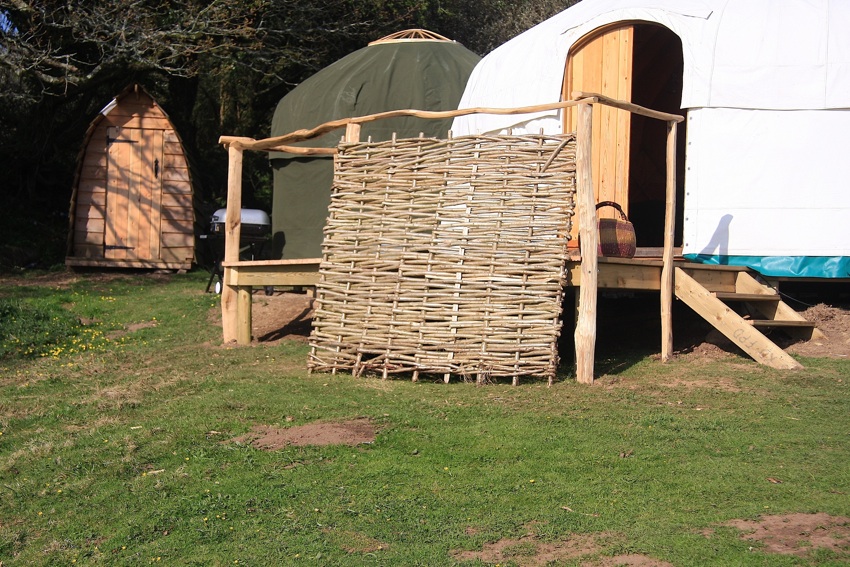
It was touch and go whether we would get it ready but the Ash Field Yurt finally had a new deck and a new pod in time for the opening day of the season. As it turns out it’s our 10th year running Cornish Yurt Holidays, an anniversary that has crept up on us, as it doesn’t seem that long ago that we started with one yurt  on the top of the hill. After that blew away in a gale we moved lower down the hill in 2005 and slowly increased the number of yurts from one to three plus the recently added Pod. After many successful seasons and two successful planning applications along the way I hope we have found a good balance for us, the land and for those who come and stay.


However when I recently had an enquiry for a possible order for over a hundred yurts for a holiday site in France I realised that we haven’t grown very fast at all. There are now so many new yurt holiday businesses cropping up all over the place, each one bigger, greener, more sustainable,  more luxurious than the last.Trailing through the directories, the web site homepages and the newspaper reviews it sometimes gets hard to tell one from the other.


Where does it all go from here? There are already multi pod yurts, yurt villages, yurt tree houses, yurts on boats , and at least one two storey yurt, so the possibilities go on, but despite the media’s obsession with what’s new, and a clear commercialisation of the alternative holiday market I’m not sure it’s about all that. Yurts work, which is why they have been around for so long, and in the right place with the right approach they can be enough in themselves. We have made Cornish Yurt Holidays the place we would like to go on holiday and very often this is the only place we go on holiday. It is always very special, even 10 years on, so we are going to keep on keeping it that way and let the place work its magic.

Tuesday, 28 December 2010

New for 2011


With the weather turning warmer in the south west at least and the new year just round the corner, the idea of spring doesn't seem so far fetched. Although wary of new year resolutions the plan is to have a few more useful entries on the blog in 2011 and to put out a newsletter every quarter...

Although there are now yurt camps with 10 plus yurts, we are keeping it small just three yurts each one in its own field, one toilet/ig-loo for each yurt, and the bathroom yurt and solar shower to share between them.


Although it was up for the last part of the season the solar shower is the most significant new addition, part up-turned boat, part gothic archway the distinctive shape and big view of moss covered hawthorn trees is a very different type of shower.


The 10ft yurt pod attached to the 20ft Ash Field yurt will be up for April 2011, giving a separate but attached yurt for the kids and space for the adults to relax more comfortably in the evening. In the bathroom yurt we have finally found a suitable comfy chair and a place to rest your cuppa or glass of wine.


We are also installing a washing machine and dryer (not anywhere in earshot of the yurts), to make it easier for to those with young families to keep on top of the laundry without traipsing off to Wadebridge or Bodmin.

Although doing very little seems to be a popular past time for many who come here, this is rarely an option if you have children. In addition to the swings and hammocks we will have a sandpit, and a big pile of sticks and stuff for building shelters. There will also be a slackline ( a kind of low level tightrope ) for the adventurous or foolhardy of all ages.

For more details of the facilities and other ideas about what to do click here

To see the 2011 calendar and tarif click here.

Friday, 19 November 2010

Wood and Rush


There is no doubt that making a chair from a tree is more difficult than it sounds, more difficult than yurt making too I am sure, but despite the obvious complexities, the notion of starting with a tree, felling it, cleaving it, axing it, drawknifing it, etc. until you have nineteen or so bits of wood that go together to make a simple chair, is a wonderful thing.
I am more proficient with the wood than with the rush seating which is how I came to spend an excellent weekend on one of Linda Lemieux courses on the edge of Dartmoor learning how to weave the rush into a chair seat. A woman of many talents and endless patience Linda grows her own willow for her beautiful baskets and harvests her rush for chair seats. The hospitality and excellent tuition makes for a great weekend . For more details see www.woodandrush.net

Sunday, 14 November 2010

World of Interiors

 Ed Osbornes hand made stoves are featured in this months issue of World of Interiors.  They have one picture of the gas bottle stove which is one of many of the full range of stoves and ranges  that he makes. Portable and efficient, easy to light and  good for cooking on we have used them for years in our yurts and have supplied them to many of our yurt buying customers.  To find out more info about Parp stoves phone 01363 860001

Tuesday, 18 May 2010

Recent cancellation

Recent cancellation - Bank Holiday weekend - 28th May

Weekend Bluebell Break for two for £160.

A short notice cancellation has come up in our 16ft Green Man yurt from the 28th May for 3 nights. It sleeps 2 with its own ig-loo just behind it. With a late spring Cornwall is looking beautiful at the moment, the yurt is surrounded with bluebells and the oak trees are just coming into leaf, and though the water in the river is still goosebump cold  the air is getting warmer and the bees are buzzing at last. Altogether too good to miss but if it doesn't get booked we may have to go down there ourselves. Click here to make an enquiry.


Thursday, 21 January 2010

Signs of Life

There's a certain mystique around the ability to read tracks and signs; a sense of wonder surely helped by a childhood spent watching old westerns where Indian scouts read seemingly invisible signs in the dust or notice a bruised blade of grass on the prairie. It was usually portrayed as a skill outside the experience of your average white man. It doesn't need to be, of course, but it is a much neglected craft and one of the most rewarding in developing our understanding of the habits of our local wildlife.
Painstaking and occasionally obsessive, tracking/sign reading is an exercise in learning to look, learning
to move with animal stealth, learning to listen, and even learning to smell in a new way. All your senses including your
intuitive sixth are finely tuned. It is part observation and part
interpretation and a perfect antidote to the channel zapping, google
scrolling that our eyes are used to. It is a way of telling stories about the
countryside, building up a picture of the creatures who live there and the
significant landmarks and boundaries of their world.

Living in such a populated country, tracking and reading signs is made more difficult by one sign being overlaid by
another. Hiking boots may be kind on your feet but they leave a heavy mark
where they tread. However when it
snows its as though a whole new landscape has been laid down in front of you.
It sometimes seems like vandalism to disturb it, but it is a perfect time to start learning to read the signs and see how much wild life is teeming
around you.

Above: Shire horse and wallaby tracks. Below: Fox and blackbird

For a good introduction see "Animal Tracks and Signs" by Preben Bang and Preben Dahlstrom