Monday, 27 July 2020

Recent Review

Simply amazing! We would go back in a heartbeat!


"We had the most wonderful week in Cornwall staying here - campfires to toast marshmallows on while listening to owls and watching shooting stars at night, to then wake up to stunning views over the Cornish countryside and the sound of birds in the trees. A truly peaceful, wonderful holiday with some many varied activities nearby, and the pub in walking distance, what more could you ask for?! Tim is a wonderful host who has thought of everything to make the holiday perfect. The woodfired bath is a must, as is experiencing having a solar heated shower whilst overlooking a forest wilderness. An amazing experience and we would heartily recommend!"
Jul 25, 2020 by Abalena22


Saturday, 18 July 2020

Cornish Yurt Holidays Availability


Although we are almost booked up for the summer, we still have some availability in July and August:

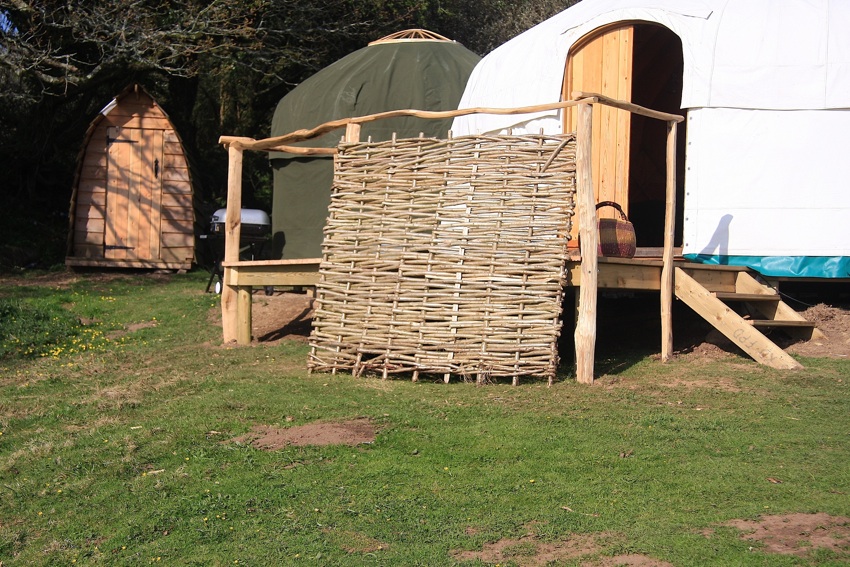
Oak Wood Yurt (pictured)(sleeps 4 on two doubles) Friday 31st July - 7th August OakwoodYurt

Green Man Yurt (sleeps 2) Friday 21st August -28th August Green Man Yurt
Both of these are for weeks stays only

There is also good availability for the yurts in September for short or weeks stays.
You can still book under the Covid scheme which asks for 20% first payment followed by the balance 10 days before your stay. For a Covid related cancellation you can rebook any time in the next 18 months.
Any queries call Tim on 07974633320

Wednesday, 16 January 2019

Yurtworks Is Changing!


There have been so many great years making beautiful yurts, but this year Yurtworks is changing!  After 22 years of professional yurt making we have decided to hang up the draw knife and turn down the steamer. We are no longer taking new yurt orders*, or doing hire for outside events. Instead we will be concentrating on Cornish Yurt Holidays here on the farm and developing other exciting circular projects which we will announce shortly

We shall be updating the website over the coming weeks and posting updates on social media, please bear with us - the new phase will be bringing together all we have learned about living in the round  in radical and exciting new ways.

A big thankyou to all the lovely people we have met and worked with in this yurty world, and to the customers and visitors who keep coming back. Wishing you all the best for the new year and looking forward to seeing you again in the coming months.

*Important news for existing customers. We will still do our best to help and support existing customers maintain their yurts with repairs and replacement covers for the foreseeable future.

Tuesday, 4 March 2014

Beech Life

There has been a lull in the weather  recently, almost enough to make you think that Spring is  around the corner. Then, just when  the first celandines  flowered in the woods and wild garlic was in the air, another blustery wind blew through with driving rain and hail, and we were back slipping through the mud again.  Despite this, we have got off lightly, the land is not underwater and it has even been possible to get a bit of tree work done between the squalls.


Back in the late 60's they felled most of the trees here that had any timber value, leaving any that were gnarly, forked or badly barked by the cattle that wintered beneath them. Some had been pollarded, perhaps to feed the cows in late summer and are now growing thick, multi stemmed and greedy for any available sunlight.
We over- wintered our cows here in '95 and '96 and the neighbour's pygmy goats used to be frequent visitors, leaping the fence to feed on anything and everything that grew there. Add  red deer, roe deer, wallabies and hordes of marauding grey squirrels and it's a wonder that there are any trees here at all.


Natural England suggested we took down all the beech trees as they were not native to the area and they were keen to see a return to ancient woodland species like oak and thorn, but beech trees bring something else to the woods, not least the luminous green moss that coats their trunks like velvet socks.


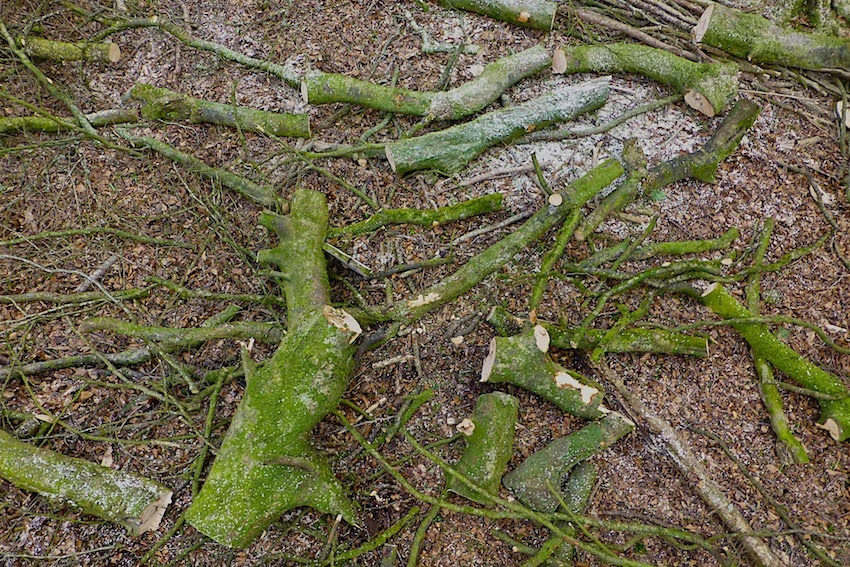
Although we have decided not to follow Natural England's advise, some of the beech that have been most damaged by the squirrels are starting to shed big limbs. Beech are also notoriously shallow rooted and so we have started to take out some of the weakest trees opening up the canopy to let more light in to the woodland floor.

Some of the trees were leaning over shading out the younger trees beneath
 We have also started running our Bushcraft and Nature Awareness sessions here and it is important for obvious reasons that the weakest trees are made safe.

The long crack running up through this trunk makes it ideal insect habitat.
Taking out some of these big old beech will let plenty of light into the wood, giving other species a chance to survive. The beech woods are beautiful especially in May when the bluebells are out, but they can be cold, windswept places in winter giving little protection or cover for the birds and other wildlife. Even at the height of summer they are dark almost gloomy places, shading out any new life that tries to establish itself.


Beech was traditionally used for furniture making up around the home counties, but this beech wood has a distinctly Cornish character to it and doesn't easily lend itself to fine woodwork. It would be shame though if it was all to end in the wood burner, so there are plans to make some big bowls and a wooden spoon or two.


Sunday, 9 February 2014

Hedgelaying

It is not always easy feeling optimistic in February, the farm animals are hungry, the birds and other wildlife too, are short of food and shelter, and the gales have left the land looking battered and worn out. Spring still feels some way off, but it is a time when the bare bones of the fields, hedgerows and woodlands reveal most and it is a great time for seeing what there is, stripped of all that verdant summer overgrowth.
Daisy the cow tree climbing on an old tumbled down hedge
 It's the time we tackle the last of the hedging and fencing work before the birds start nesting. Most of the hedges around here are traditional Cornish* -  earth filled, granite faced and topped with blackthorn, oak and hazel. They are a bit tumbled down in places, generations of cattle sensing that it's always greener on the other side has taken its toll. Countless rabbits too, have burrowed into the heart of the hedges so they sag and slump.

Hedge before laying
We are slowly trying to put them back up if they are not too far gone and wherever we can we lay the trees and shrubs that grow along the top. Hedge laying or steeping is  a practice that has gone on for hundreds of years  although it was never that common in these parts. This hedge in particular doesn't look like much but there could well have been a hedge of some sort here for a 1000 years or more. I like this about hedges, they are  easily passed by but like old bones they are remnants of a very long ago past.
S. on the last stretch 
I learned to lay hedges with the help of the Devon Rural Skills Trust and used the skills for  several years in combination with post and wire fencing work. Back then it was rare to see a hedge laid in Cornwall and if you did it was usually lashed down with orange baler twine. Most of my jobs came from Devon and even then it was not always easy convincing customers that a laid hedge was the way to go. Nearly 20 yrs on the situation hasn't improved much, and although awareness about the value of hedges has grown, few people can make a living from this old craft. My hedge laying skills are a bit rusty so Steve, a local hedgelayer, took the job on.

Laid and crooked to hold it in place
One of the reasons for laying this particular length is to lower the hedge line so the butterflies can cross more easily. You would think they would be able to fly over the hedge even with trees on it but the Pearl Bordered Fritillary is not so bold; wary of heights,  they are easily discouraged when they come up against a tall hedgerow.

The hedge will reshoot in the spring


Unfortunately the mechanical flailing of hedges has almost completely extinguished the beautiful craft of the hedge layer. It has also had the same effect on  the wildlife and wildflowers that depend on them. Some say that flailing is good for  hedges on the general principal that a cut hedge is better than an overgrown one, but  there is now plenty of evidence to show that the repeated flailing of hedges is killing off the hedgerow trees and shrubs  and the diversity of wildlife that live in them has suffered as a result. 
Flailing hedges in Devon
It's unlikely that the hedge laying craft will return in a big way any time soon, as it is not seen as cost effective, but when whole species disappear from an area as a result of flailed hedges how much richer are we?

As soon as economics is the dominant factor in countryside management it rarely bodes well for the creatures that live there. Perhaps the more awareness grows of these almost extinct heritage crafts like hedge laying and the benefits they can bring, the tide may slowly turn. After all, the riches of the countryside should continue to be a reference to the variety of life that lives in the country and not to the money that is to be made there.

* The Cornish Hedges website is a great source of information and includes a detailed history of a single mile of Cornish hedgerow from the 60's to 2008 by Sarah Carter. Her 90 page study soon dispels any preconceptions that  flailing is not so bad after all.


Sunday, 12 January 2014

Slow Start

 It has been a slow start to the new year but slow, I am sure, is good. We have started cutting, clearing and burning on some land  that has been mostly left alone for the best part of 50 years, so there is no need to rush it.
Gorse bushes grow as tall as trees
It is one of those places where Nature has been left to do its thing. The trees have grown tall and lanky. The gorse, moss covered and luminous green, is 25ft tall in places. Honeysuckle curls and twists around the thorn trees. Granite boulders stick up like giant stepping stones in the bracken. Last years nests are cradled but crumbling in the forks of branches. It is one of those long forgotten corners which a large part of me wanted to leave well alone.

Some of the gorse will be left for nesting birds

"But it's no good for butterflies" said the man from Natural England who had come to assess the habitat for butterfly potential. He cast a despairing look over the hillside covered in a tangle of thorn, gorse and bramble. " It will all have to go, it has almost no wildlife value at all."

Since then it has taken a few years to fully embrace the butterfly project on this patch of hillside but on reflection the  wildness of this place is not ancient, there are signs everywhere of human activity; the old granite hedges, the leats and tailings of an old copper mine, hazel and oak coppice stools, granite boulders split and cut for lintels and gateposts, even an old hammock made from a fishing net 35 years earlier. This is a place that has known people for centuries.


Clearing the scrub around the old copper mine
And as for the wildlife, the trees have grown up in all their beautiful moss covered  lankiness, but it has got darker, damper and the variety of species of plant life, has grown less.  Barely any sunlight penetrates even in winter and apart from a bit of ivy the ground is bare and the understory hollow. What I once thought of as a wildlife sanctuary, has become more and more like a wildlife dead zone.


The cows follow the saw browsing on hazel tops and ivy
Although it is a radical approach, any management, that increases the biodiversity of a place, must be a good thing and although the work here is targeted particularly at the butterflies, I am sure that other species will benefit  as well.


 So now when there is that smell of two stroke in the air and the sound of the chainsaw rips the air,  it feels brutal,  but I know it will bring more, not less, life to this tiny patch of land. After all, the chainsaw work will soon be done, the fires burned out,  replaced by the gentle foraging of the cows.


Tuesday, 31 December 2013

Yurtworks Update

Welcome back to the Yurtworld blog. It is the last day of the year and I notice that posts have not been very frequent. For 2014  we shall try and be more diligent in covering aspects of yurt life, yurt making, yurt holidays as well as the work on the land here that has kept us busy these last few years.
Our 25ft traditional Kyrgyz style yurt at an event on Dartmoor 

We had a really good yurt holiday season this year, thanks to all those who came and loved the place and the yurts so much.

The conservation work for the Pearl Bordered Fritillary butterfly is ongoing. Apart from ourselves the workforce is made up of five traditional Hereford cows who have settled in well and are doing a great job foraging through the thick bracken and bramble. Blackthorn thickets are slowly being thinned out, hazel coppiced, and hedges laid.

Down by the river we are thinning out the trees planted in 1995, this is providing us with plenty of material for spoons, bowls, chairs and hopefully a longbow or two. We shall be doing more posts on these crafts as the year goes on.

All this land work has taken us out of the workshop so yurt making has been on a slow burn this year, and will continue to tick over in 2014. I have restarted a yurt book begun in 2005 after my second visit to Mongolia and hope that the photos and research will be available soon in book or online form.

We always used to take on volunteers and plan to start again in the spring, providing a simple yurt for accommodation. The work will be more land based than workshop based but could appeal if you are interested in approaches to the handmade life and working with the land. More details about this will be posted on future blogs and the Yurtworks Facebook page.

In the meantime have a very  happy new year, and hope to see you in 2014.


Saturday, 25 August 2012

“Yurt Living: How yurts bring us closer to nature”


After years of living a city life, and feeling the effects of a lost connection with my rural roots, I went back to live in the country to work with trees. There was no big plan. One of the more romantic ideas was to plant a musical woodland - maple and rosewood for guitars, spruce for violins etc. It was a shortlived idea dreamed up in a Spanish city where trees in their pollarded contortions, were a decorative backdrop to city life. .

That was nearly twenty years ago and although the musical arboretum was the first and the most misguided of many ideas it raised the question early on as what my place could be in the countryside after so long a displacement.

Green Woodworking

My way back along this natural path started with green woodwork, which at the time was beginning its slow renaissance inspired by the late Bill Hogarth, and led by Mike Abbot, Hal Wynn Jones and others.

Unlike modern carpentry, the starting point with green woodwork is the tree itself and not a stack of timber in a DIY store. Learning the names of our native trees and their properties, their stories and management, about coppicing, pollarding, the underwood and the wildwood, the countryside slowly started to be more familiar and less strange. All of a sudden a new world opened out and a walk in the woods was never the same again.

Green woodwork follows the grain of the wood, mirroring the natural curves of the tree. It retains that link with what it was as a tree right through to what it will become.

 Working with what you find growing in your local woods rather than what has been imported and industry graded, teaches you a new way of seeing .You learn to use the knots, the awkward bends of the wood, the spirals caused by honeysuckle on a hazel rod for example; your eye learns a new greenwood language.

Children of almost any age can work with green wood; I spent many hours supervising children as young as three as they whittled pointy sticks with teeth gritted determination. (Despite the length and sharpness of the blade, a drawknife, if properly handled, is a very safe tool).

To start with we didn’t use a tape measure but instead used body measurements so that the chair, stool or yurt would be made using your own proportions just by taking a measurement off your hand or outstretched fingers. You could be numerically dyslexic and still make stuff.

My first yurt followed some months after these discoveries, and became, without ever intending it, the first of many. I lived in it for a year and after a short while people started asking me to make others. Local shows and festivals were the lifeblood of rural crafts before the Internet appeared and it was through one of these that a chance meeting led to a visit to the ancestral home of the yurt in Central Asia.

The Ancestral Home of Yurts

I had heard of whole valleys on the far western borders of Kyrgyzstan covered with yurts as far as you could see.  This National Geographic picture of the country that I held in my head was romantic but wrong. If the Kyrgyz had not turned their backs on their nomadic life completely, the process was well underway by the time I got there. Independence from the old Soviet Union had meant that that the export market for sheep, the mainstay of their economy, had collapsed. With so few sheep it was no longer viable to spend the summer months up in the mountain pastures in their yurts.


In the countryside the yurts that once crowded the valleys were now more frequently erected by the roadside as cafés or stalls selling mares milk (kumis), watermelons and coca cola.
In the city, the yurts were often left unassembled in apartment corridors and old garages, and erected only for weddings and funerals.

The visit to Kyrgyzstan was followed by two trips to Mongolia to learn about the Ger with its low flat profile, straight roof poles and supporting poles (bagana) in the centre, very different from the Central Asian Yurt with its tall, steep, domed outline with bent roof poles and open central space.

 Similar moves were taking place in Mongolia with a third of the population living in and around the capital Ulaan Bator, but many Mongolians still lived in their gers even in the city itself. The connection to their nomadic roots is still very strong and it was not unusual to meet university students who could whittle from a piece of wood, spin wool, do embroidery, sew and of course they could all ride a horse, though most now didn’t need to.

Traditionally yurts and gers are made from wood  (willow, larch, birch) for the frame and sheep’s wool felt for the covering and are held together with horsehair cord, rope and rawhide. The animals the nomads depend on and the earth they live on provide the materials they make their homes with.
The decoration inside can be plain or ornate, the wood painted or carved, the tent bands woven, the wall hangings stitched and embroidered.

The interior lay out reflects a distinct social order, there is a place for women, place for men, a place for honoured guests, for the shrine, and for cooking, there is respect given to the elders, a reverence for the wheel,“the eye to the heavens” and the stove, always in the centre where the four elements, earth, air, fire and water meet.
The two bagana (central supports) in a Mongolian ger should not be leaned against. They are usually made of birch, a sacred tree and are a symbolic link between the earth and the sky.

The manufacture and decoration of yurts and gers, the way they are used embody a whole culture, a culture that has a deep respect for the earth, for the role of the family and the ways the two come together.

If the migrations in Mongolia and Kyrgyzstan were towards the cities, a move in a different direction was underway in the UK. Escape to the Country TV, Country Living Exhibitions and River Cottage recipes  fuelled our appetite for rural life as people were moving to the country in search of more fulfilling lives.

As this interest in country living grew, so too did an interest in yurts; more people wanted to buy them, make them, live in them, run schools in them, dance and tell stories in them, and to holiday in them.

Yurts as nurturing spaces

So if we weren’t turning into nomads what exactly was the appeal of these round tents? Our ancestors lived in round houses of one sort of another and perhaps deep down we find the round space and communal family living, supportive and nurturing.

The yurts we make at Yurtworks are from wood that has grown locally, and while some machines are used in the process they are made principally by hand, with the marks of the hand tools left on the wood.  They are made from ash (the Norse “tree of life “) and although they have some modern components so that they work well in our climate they retain the spirit of their Mongolian and Kyrgyz counterparts.


When someone speaks or sings in a yurt you tend to listen more intently. The domed roof provides a good acoustic and words are not lost down corridors or your eye distracted by corners and windows. When you are inside you are properly inside not gazing out at the view.

Living in a yurt involves the whole family usually in a single room, and when you share a space so closely you have to be organised, respect each other and work together. Our experiences of yurt living began when our youngest was 13months old. The cold nights of May were kept at bay with layers of woollen blankets. The night feeds led to fires being rekindled accompanied by the call of owls in the oak trees nearby, then snuggling under the covers again to awaken with the yurt warm and ready for the coming day.

Both our children of 4 and 15 years still enjoy yurt life. The circular space means we are always together, within sight  which is very reassuring and creates an immense sense of security.  Opening the door to a diverse and beautiful landscape, brings a sense of connection to the earth, the animals here and to our ancestors. A chance encounter at dawn as a deer listens to the wind unaware of other eyes watching.

It is a very powerful reminder that we share this land with so many other creatures and that we are a small part in the jigsaw.
The daily tasks can be shared out, the collection of wood, lighting the fire, fetching water, lighting candles , drying clothes, washing, cooking etc. It all takes longer and it is no less repetitive than in a house.

Evenings are marked with the ritual of lighting lanterns, a magical light with shadows dancing on the roof space. Stories and songs bring a gentle close to a busy day. Adapting life to daylight hours is a welcome change, allowing us rest time, free from other distractions which a house provides.The solar lighting, a useful aid when cooking, reading and doing paperwork is our only source of electricity.

When the manual tasks, the so called chores, take up more time the distinction  between work and life becomes blurred.
This is one of the myths perhaps, this idea that there is  the right balance between work and life as if they were different from each other.  It has taken me a while to realise that work, when you can bring your heart, head and hands into what you do, IS life. Work is not always  soulless toil and life is not a quest  for some kind of hedonistic utopia.

 As the Mongolians and the Kyrgyz continue on their paths away from their nomadic lives towards the cities and their own industrial and technological revolutions, many in the west are starting to journey in the opposite direction to make their own old earth connections.

If we carry with us a sense of humility and a belief that we can be a life giving presence in Nature and not a destructive one, perhaps we shall find our place there again.

Tim Hutton and Naomi Parslow

Published in Juno magazine June 2012


Monday, 30 April 2012

Yurts on Film


 I recently watched Tulpan (Tulip) a great film about a young Kazakh man returning to the steppe after his military service with dreams of owning his own yurt, marriage to the elusive Tulpan, and owning his own flock of sheep. It is a beautiful film of a man's determination to return to live on the land, a land of extreme hardship right on the edge of life itself. He turns his back on the navy and the city, to live in this beautiful almost barren plain which almost everyone else has already abandoned, to suffer the humiliations of his brother in law who ensures that this rite of passage is not an easy one.
Other films with yurts....

1.Urga -  A Russian truck driver breaks down in the middle of the Mongolian steppe where he meets Gombo a mongolian nomad and an unlikely friendship develops.
2. Tulpan
3. Mongol - A great epic of a film about Chingis Khan's early life, lots of yurts, horses and blood.
4.The Story of the Weeping Camel
5.The Cave of the Yellow Dog

There is also Troy and The Golden Compass which use yurts albeit fleetingly in one or two scenes, there must be many more films or references so  please add any unusual, interesting or trivial  yurt stuff that you come across.


Monday, 30 January 2012

Frontier Stoves from Cornwall


The Frontier stove is made by Camping Solutions, in Cornwall, initially developed for disaster relief agencies, it incorporates plenty of features that make it a useful bit of kit for the domestic market as well. Long gone are the days of roughing it in drippy nylon tents. The advent of bell tents, safari tents, domes, pods and yurts, shows that we like our camping a little bit more comfortable than previously and if this means taking some of the mod cons camping then so be it. I personally draw the line at the kitchen sink, but a stove, that's a bit different, a stove can make the difference between misery or magic, divorce or devotion. It is easy to dream of sitting around the campfire in the evening with stars overhead, but due to the weather or overzealous regulations it is not always possible to have a campfire outside. So a lightweight stove like this is a perfect solution.

The Frontier stoves are very compact: the three legs fold up under the body of the stove, all the lengths of flue slide inside the fire box and even the small ember tray below the door can be unclipped and put inside to prevent it catching or getting lost. Packed up, it only measures length. 450mm x d.200mm x w.250mm. and assembly takes a matter of minutes. It even has its own carrying handle.

I was concerned that the size of the flue (60mm) would not provide adequate draw but in practice found it was easy to light and no problem to keep in, of course, like all fires and stoves, the drier, more seasoned wood you put in it the better it will burn. There is a baffle on the first section of flue to limit the draw and the door latch has a small catch to allow more draft through the door. The flat top is perfect for boiling a kettle on or frying up some eggs, constructed from mild steel it takes very little time to heat up to a useful cooking temperature.

There is no reason why it should only be used inside a tent or other structure, it is also just as useful outside in the same way that you might use a barbecue. The five lengths of flue are self supporting (although they would be safer supported ) and they do get hot, being uninsulated, so you would need to be mindful when there are children about. The stove itself heats up very quickly, so again you would need to be cautious with children running about, but that applies to all fires. The tripod legs are locked in place and provide a very stable support.

The Frontier Stove is unlikely to replace the wood burners in more permanent settings, but would be ideal for temporary camps especially if you were running some bushcraft or similar outdoor activities and you needed an indoor/undercover source of heat and cooking. The price of £129.99 plus £9.99 p & p from campingsolutions.co.uk makes it a useful bit of kit that will keep you warm without burning a hole in your pocket.

Tuesday, 3 January 2012

Low Flying Butterflies at Risk.


Although the rare pearl bordered fritillary butterfly has been here for some time we haven't been able to do as much as we would have liked to encourage it, a little bit of ride clearance here and there, some bracken control etc. However we have recently signed up to a 10 year land stewardship scheme with the aim of doing more to help it survive. This will involve increasing the stocking rate on the farm, making more rides through the bracken and brambles, cutting back some of the scrub growth and some more coppicing of the overstood hazel stands.

There are a number of reasons for the butterflies demise, most linked to the way the land is managed, among them is the decline of violets , the principle food plant; the spread of dense scrub due to an absence of foraging/browsing animals hasn't helped either, and the overgrowth of traditional coppice into small woodlands presents high barriers that the butterfly cannot fly over or around.

The english countryside has been managed by man for so long there are no pockets of wilderness left and while it is often over managed or badly managed, I am broadly speaking in favour of any kind of management that will increase rather than diminish the biodiversity of an area. It is true the pearl bordered fritillary with its reluctance to fly high, requiring low level heathland without too many obstacles like hedges and woodland to hinder it, will not be quite as versatile as its more adaptable cousins like the silver washed fritillary, but it will be a great challenge to see if we can bring a greater variety of life to this hillside and help the butterflies at the same time.
With only 2 months left before the nesting season starts we start work this week. If you live locally and would be interested in helping out for a day or two please get in touch.

Tuesday, 31 May 2011

10 Years On.

It was touch and go whether we would get it ready but the Ash Field Yurt finally had a new deck and a new pod in time for the opening day of the season. As it turns out it’s our 10th year running Cornish Yurt Holidays, an anniversary that has crept up on us, as it doesn’t seem that long ago that we started with one yurt  on the top of the hill. After that blew away in a gale we moved lower down the hill in 2005 and slowly increased the number of yurts from one to three plus the recently added Pod. After many successful seasons and two successful planning applications along the way I hope we have found a good balance for us, the land and for those who come and stay.


However when I recently had an enquiry for a possible order for over a hundred yurts for a holiday site in France I realised that we haven’t grown very fast at all. There are now so many new yurt holiday businesses cropping up all over the place, each one bigger, greener, more sustainable,  more luxurious than the last.Trailing through the directories, the web site homepages and the newspaper reviews it sometimes gets hard to tell one from the other.


Where does it all go from here? There are already multi pod yurts, yurt villages, yurt tree houses, yurts on boats , and at least one two storey yurt, so the possibilities go on, but despite the media’s obsession with what’s new, and a clear commercialisation of the alternative holiday market I’m not sure it’s about all that. Yurts work, which is why they have been around for so long, and in the right place with the right approach they can be enough in themselves. We have made Cornish Yurt Holidays the place we would like to go on holiday and very often this is the only place we go on holiday. It is always very special, even 10 years on, so we are going to keep on keeping it that way and let the place work its magic.

Tuesday, 28 December 2010

New for 2011


With the weather turning warmer in the south west at least and the new year just round the corner, the idea of spring doesn't seem so far fetched. Although wary of new year resolutions the plan is to have a few more useful entries on the blog in 2011 and to put out a newsletter every quarter...

Although there are now yurt camps with 10 plus yurts, we are keeping it small just three yurts each one in its own field, one toilet/ig-loo for each yurt, and the bathroom yurt and solar shower to share between them.


Although it was up for the last part of the season the solar shower is the most significant new addition, part up-turned boat, part gothic archway the distinctive shape and big view of moss covered hawthorn trees is a very different type of shower.


The 10ft yurt pod attached to the 20ft Ash Field yurt will be up for April 2011, giving a separate but attached yurt for the kids and space for the adults to relax more comfortably in the evening. In the bathroom yurt we have finally found a suitable comfy chair and a place to rest your cuppa or glass of wine.


We are also installing a washing machine and dryer (not anywhere in earshot of the yurts), to make it easier for to those with young families to keep on top of the laundry without traipsing off to Wadebridge or Bodmin.

Although doing very little seems to be a popular past time for many who come here, this is rarely an option if you have children. In addition to the swings and hammocks we will have a sandpit, and a big pile of sticks and stuff for building shelters. There will also be a slackline ( a kind of low level tightrope ) for the adventurous or foolhardy of all ages.

For more details of the facilities and other ideas about what to do click here

To see the 2011 calendar and tarif click here.

Friday, 19 November 2010

Wood and Rush


There is no doubt that making a chair from a tree is more difficult than it sounds, more difficult than yurt making too I am sure, but despite the obvious complexities, the notion of starting with a tree, felling it, cleaving it, axing it, drawknifing it, etc. until you have nineteen or so bits of wood that go together to make a simple chair, is a wonderful thing.
I am more proficient with the wood than with the rush seating which is how I came to spend an excellent weekend on one of Linda Lemieux courses on the edge of Dartmoor learning how to weave the rush into a chair seat. A woman of many talents and endless patience Linda grows her own willow for her beautiful baskets and harvests her rush for chair seats. The hospitality and excellent tuition makes for a great weekend . For more details see www.woodandrush.net

Sunday, 14 November 2010

World of Interiors

 Ed Osbornes hand made stoves are featured in this months issue of World of Interiors.  They have one picture of the gas bottle stove which is one of many of the full range of stoves and ranges  that he makes. Portable and efficient, easy to light and  good for cooking on we have used them for years in our yurts and have supplied them to many of our yurt buying customers.  To find out more info about Parp stoves phone 01363 860001

Tuesday, 18 May 2010

Recent cancellation

Recent cancellation - Bank Holiday weekend - 28th May

Weekend Bluebell Break for two for £160.

A short notice cancellation has come up in our 16ft Green Man yurt from the 28th May for 3 nights. It sleeps 2 with its own ig-loo just behind it. With a late spring Cornwall is looking beautiful at the moment, the yurt is surrounded with bluebells and the oak trees are just coming into leaf, and though the water in the river is still goosebump cold  the air is getting warmer and the bees are buzzing at last. Altogether too good to miss but if it doesn't get booked we may have to go down there ourselves. Click here to make an enquiry.


Thursday, 21 January 2010

Signs of Life

There's a certain mystique around the ability to read tracks and signs; a sense of wonder surely helped by a childhood spent watching old westerns where Indian scouts read seemingly invisible signs in the dust or notice a bruised blade of grass on the prairie. It was usually portrayed as a skill outside the experience of your average white man. It doesn't need to be, of course, but it is a much neglected craft and one of the most rewarding in developing our understanding of the habits of our local wildlife.
Painstaking and occasionally obsessive, tracking/sign reading is an exercise in learning to look, learning
to move with animal stealth, learning to listen, and even learning to smell in a new way. All your senses including your
intuitive sixth are finely tuned. It is part observation and part
interpretation and a perfect antidote to the channel zapping, google
scrolling that our eyes are used to. It is a way of telling stories about the
countryside, building up a picture of the creatures who live there and the
significant landmarks and boundaries of their world.

Living in such a populated country, tracking and reading signs is made more difficult by one sign being overlaid by
another. Hiking boots may be kind on your feet but they leave a heavy mark
where they tread. However when it
snows its as though a whole new landscape has been laid down in front of you.
It sometimes seems like vandalism to disturb it, but it is a perfect time to start learning to read the signs and see how much wild life is teeming
around you.

Above: Shire horse and wallaby tracks. Below: Fox and blackbird

For a good introduction see "Animal Tracks and Signs" by Preben Bang and Preben Dahlstrom


Thursday, 14 January 2010

Cornish yurt Holidays - new for 2010

All this snowy weather has provided a much needed if not entirely welcome opportunity to catch up on the office work. We’ve been making a few changes to the website so that it gives more information about the place and what we do here. The new Cornish Yurt Holidays website, which will run along side the Yurtworks site will be up and running by the middle of February but in the meantime…

The new booking calender has already made it much easier for people to see what is available and the price of each week.


The gallery page has more photos of the farm, the yurts and what to see around and about.


We are staying with just three yurts so that we retain the peace and seclusion of the place. However we are making a few improvements to ensure that it’s a yurt experience visitors remember for all the right reasons.


We are making new double beds for all the yurts from local wood; a king size in the 20ft Ash Field Yurt and standard doubles in the two others. Futons are great and we will keep one in each of the 20ft Ash Field and 18ft Oak Wood Yurt, but a proper bed and mattress gives that touch more comfort and loads more storage underneath.


Along with the Farm Walk Map we shall be providing more information of local walks in the area. One of the beauties of the place is that you can just start walking from your yurt to explore some lovely places without getting into your car. The two tallest tors in Cornwall, Roughtor and Brown Willy can both be walked in a day from the village with grand views that take in the north and south coasts.


The solar shower will be up and running by the start of the season. We are building a wooden shower building similar to our Ig-loos , a bit like an upturned boat with a vaulted roof and cedar cladding.. The bathroom yurt remains the same apart from a new set of covers.


Because we are replacing them with beds we have two futons for sale if you are interested please let us know.

Monday, 23 November 2009

Kyrgyz-British Society Launch

Recently in London I went to the launch of the new Kyrgyz - British Society a smart do in the Hyatt Regency Hotel in Portman Square attended by the ambassador, diplomatic staff, writers, business men, magazine publishers, aid workers and one yurtmaker.
The Society is a new initiative to promote Kyrgyz culture, business opportunities and tourism in the UK. The idea is to arrange various events through the year for Kyrgyz nationals resident in the UK and for anyone else interested in Kyrgyz life, culture and business.
Membership is £50 for the year, the website is still under construction but you will find contact details on the website.

Thursday, 1 October 2009

End of Season offers

As the season draws to an end the weather seems to get better and better, with barely any sign of the wet for over three weeks. Visitors have been making the most of the sunshine with early morning dips in the river and at last we get some evenings with a fiery sun setting behind the campfire.

We still have a few vacancies at a special end of season price of £180 for two people for four nights, they are midweek breaks so not ideal for everyone but when the weather is this good you have to  make the most of it. Availability from 12th October - 16th October and from 19th-23rd October.

We close at the end of October and all the yurts come down for the winter. The calender for next year will be going up shortly as will a new Cornish Yurt Holidays website, but for those who like to plan ahead we are already taking bookings for next year.